Who Decided Longitude Should Begin at Greenwich?
Zero degrees longitude passes through Greenwich, England, but nature did not place a visible starting line there. Governments selected it through an international vote.
Unlike the equator, which is determined by Earth's rotation, any line running from pole to pole could serve as zero longitude. For centuries, countries produced maps using different starting meridians, including Paris, Rome, Cádiz, and Washington.
This became increasingly inconvenient as ships, railways, telegraphs, and international trade connected the world. A location described on one nation's chart could have different longitude coordinates on another.
In 1884, delegates representing twenty five nations met in Washington to recommend a common prime meridian. Greenwich held a powerful practical advantage. Nearly two thirds of the world's ships were already using nautical charts based on the Royal Observatory there.
The proposal received twenty two votes. San Domingo, now the Dominican Republic, voted against it, while France and Brazil abstained. France continued using the Paris meridian for years before fully accepting the international standard.
The conference did not create the physical line or make Greenwich the natural center of Earth. It chose the reference point from which maps, navigation, and global time could agree.
The center of world longitude exists in Greenwich because enough countries decided that changing every existing chart would be harder than accepting the line most sailors already used.
Source: Greenwich Time and the Discovery of Longitude, Derek Howse - What Is the Prime Meridian and Why Is It in Greenwich? Royal Museums Greenwich
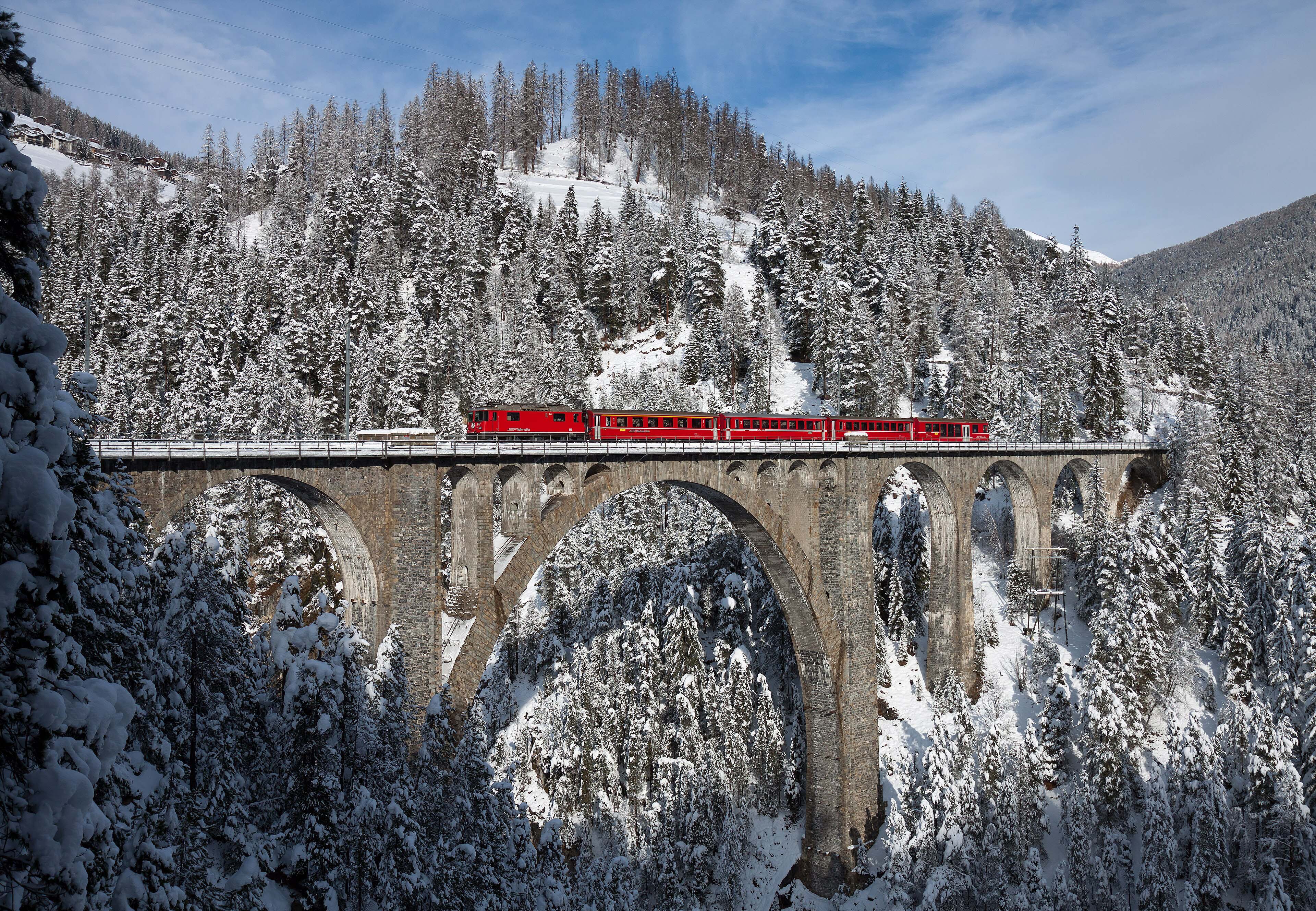
RhB train crosses Landwasser Viaduct, Switzerland
Source: David Gubler