Why Do Soap Bubbles Contain Moving Rainbows?
The colors of a soap bubble do not come from colored soap. They are created when white light reflects from two surfaces separated by a film thinner than a human hair.
A bubble wall contains a layer of water held between soap molecules. When light reaches it, some reflects from the outer surface. The rest enters the film, then some of that light reflects from the inner surface and returns toward the observer.
The two reflected light waves have traveled slightly different distances. When they meet, waves of certain colors reinforce one another, while others cancel. This process is called thin film interference.
Which colors survive depends on the film’s thickness, the viewing angle, and the wavelength of the light. Since the thickness varies across the bubble, different areas reflect different colors. Gravity pulls liquid downward, while evaporation and air currents continually reshape the film. The colored bands therefore slide, swirl, and change.
As the bubble becomes extremely thin, the reflected waves can cancel across much of the visible spectrum. A dark or nearly transparent patch often appears near the top shortly before the bubble breaks. This is not dirt or shadow. It is a warning that the film has drained to a thickness at which very little visible light returns to the eye.
Similar colors appear in oil films and other extremely thin transparent layers.
A soap bubble is therefore not painted with a miniature rainbow. Its surface sorts ordinary white light according to thickness, turning changes too small to see directly into moving bands of color.
Source: Thin Film Interference, HyperPhysics, Georgia State University - The Science of Soap Films and Soap Bubbles, Cyril Isenberg
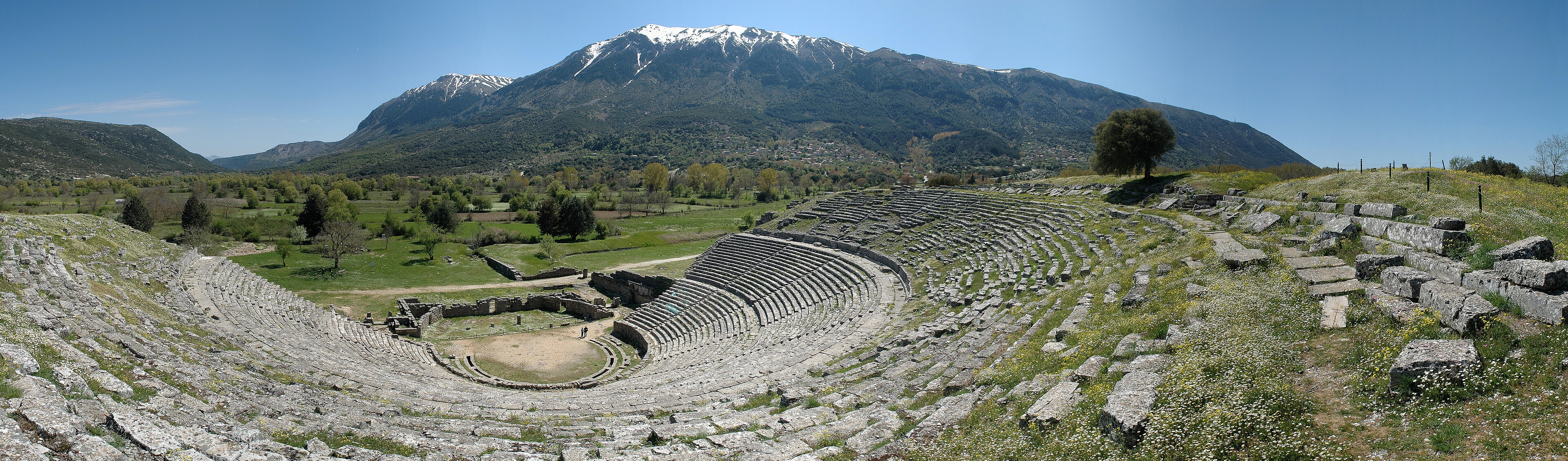
The ancient theater of Dodona, Epirus, Greece
Source: By Onno Zweers