How Can a Hummingbird Remain in One Place While Flying?
Most birds stay airborne by moving forward. A hummingbird can stop in front of a flower and remain almost motionless while its wings continue moving too quickly for the eye to follow.
Its unusual ability begins at the shoulder. A hummingbird’s wing can rotate much farther than the wing of most other birds. Instead of simply flapping up and down, it sweeps forward and backward in a flattened pattern while twisting during each stroke.
Ordinary birds produce most of their lift during the downward stroke. They partly fold their wings during the upward return to reduce resistance. A hummingbird keeps its wings extended and turns them so that both portions of the cycle contribute to lift. The downward stroke produces most of the upward force, but the reversed wing continues producing substantial lift during the upward stroke.
The moving wings also create swirling structures in the air called vortices. Differences in pressure around the wings produce the force that supports the bird’s weight.
Hovering is extremely demanding. Some hummingbirds beat their wings dozens of times each second, supported by powerful flight muscles and a rapid supply of oxygen and energy. This is one reason they feed frequently on sugar rich nectar while also eating insects for protein and other nutrients.
To fly backward, the bird tilts the plane of its wing movements so part of the force points in the required direction.
A hummingbird does not hover by beating its wings faster than an ordinary bird alone. It has transformed nearly the entire wing cycle into a continuous system for producing lift.
Source: Aerodynamics of the Hovering Hummingbird, Nature - Hummingbird Flight Physiology, Philosophical Transactions of the Royal Society
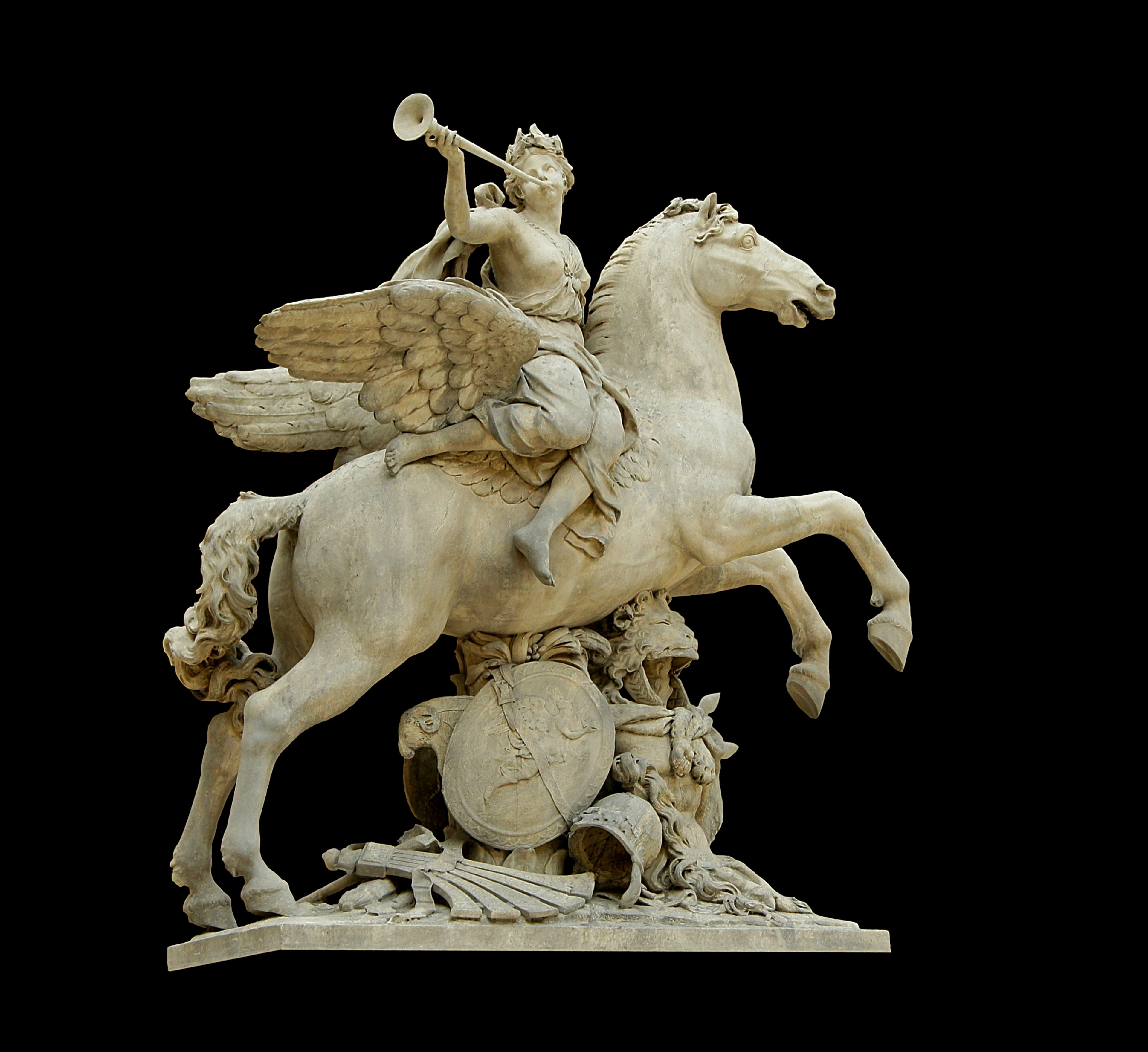
La Renommée du roi (Fame Riding Pegasus) (1701-1702)
Source: By Antoine Coysevox