Why Does Most of the World’s Coffee Grow Inside One Belt?
Most coffee begins its life within a broad band circling the middle of Earth. This region, commonly called the Coffee Belt, lies roughly between the Tropics of Cancer and Capricorn.
Coffee plants evolved in warm climates and are demanding about where they grow well. They need temperatures that remain relatively mild, enough rainfall to support growth, and seasons that encourage flowering and fruit development. Frost can severely damage them, while extreme heat may accelerate ripening, stress the trees, and reduce quality.
Latitude alone does not create good coffee country. Elevation changes the conditions dramatically. In tropical regions, highlands can provide cooler days and nights than nearby lowlands. Arabica coffee is often grown on elevated slopes where its cherries mature slowly. That longer development can allow sugars, acids, and aromatic compounds to form in ways valued by coffee drinkers.
Mountains also create different rainfall patterns, soils, and exposures to sunlight. Volcanic regions are famous for coffee, although volcanic soil is not a magical requirement. Drainage, mineral composition, farming methods, shade, plant variety, and processing all influence the final cup.
The belt crosses Latin America, Africa, Asia, the Pacific, and parts of the Caribbean. Coffee from these regions can taste remarkably different even though the farms share similar latitudes.
The Coffee Belt is therefore not a painted boundary beyond which a coffee tree cannot survive. Coffee can be grown experimentally elsewhere under protected conditions. It marks the part of Earth where climate, altitude, and seasonal rainfall most often combine to make commercial coffee cultivation practical. Nearly every cup carries a small climatic signature from that narrow ring around the planet.
Source: Climate and Coffee, National Oceanic and Atmospheric Administration - Coffee Regions of the World, National Coffee Association
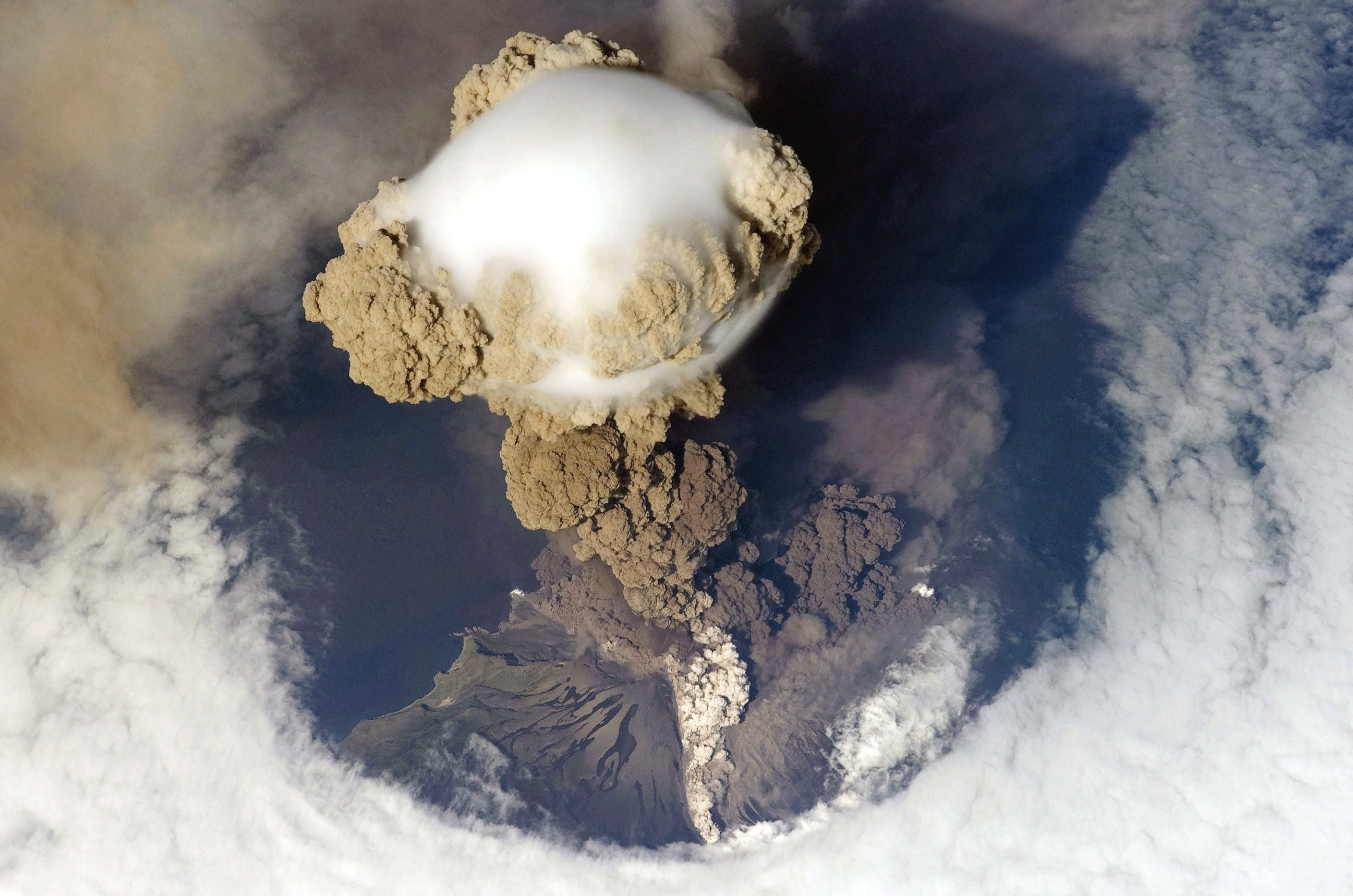
Sarychev Peak Volcano erupts June 12, 2009, on Matua Island (North Kuril Islands)
Source: By NASA